Latest news


A huge thank you to everyone that took part in The Thomas Hardy Society 2025 Human Shows Centenary Competition.
The entries received were of a very high standard, and our judges had a difficult task to determine three clear winners.
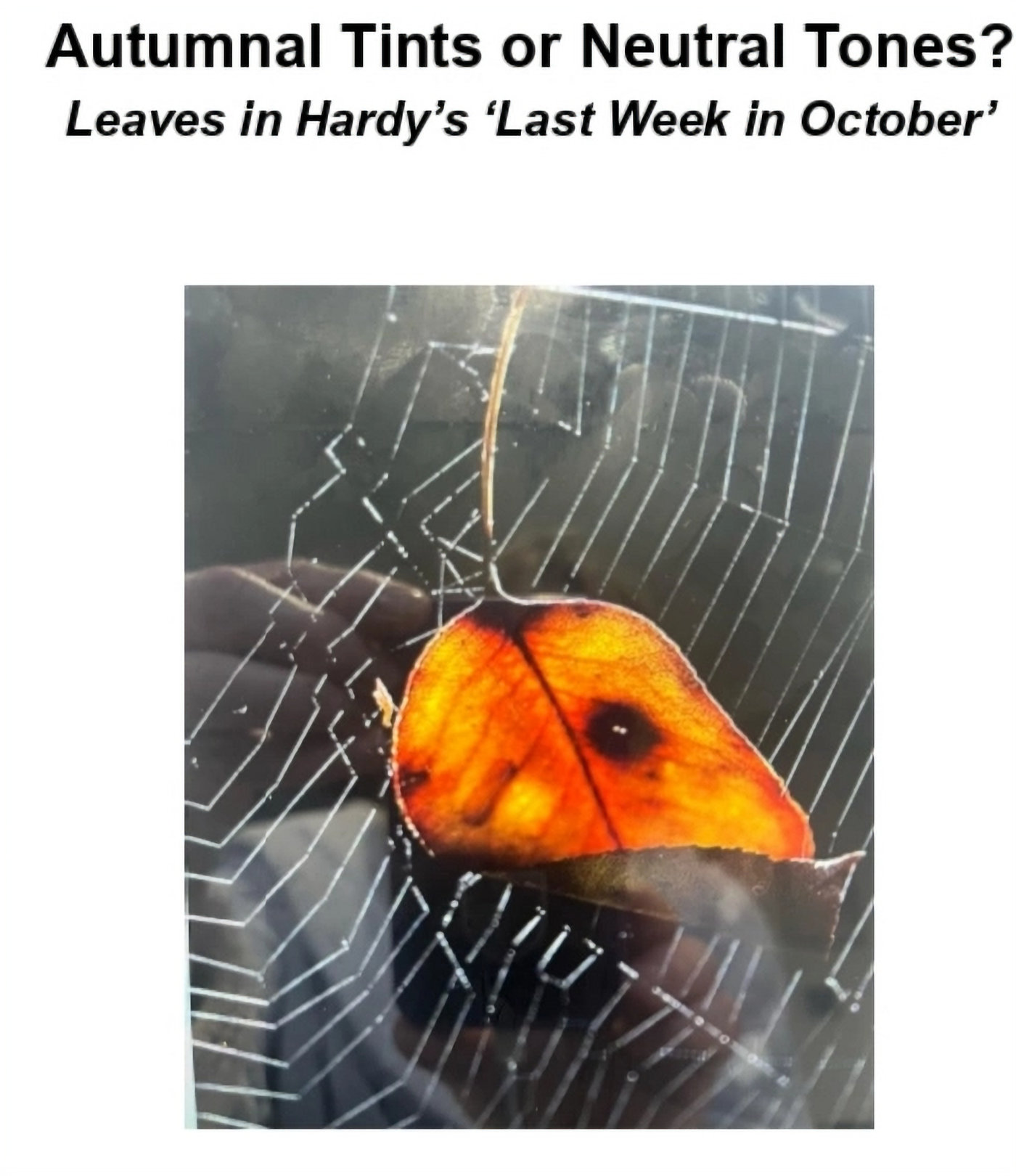
In his classic essay “Autumnal Tints”, the philosopher Henry David Thoreau celebrates the “brilliance of autumn foliage” in New England at Walden Pond where as a transcendentialist, he found beauty, spiritual truth and goodness in nature. Somewhat controversially, in the opening paragraph, he makes the bold - and erroneous - assertion that English poetry barely recognises Autumn’s vivid colours.
Certainly, some of Thomas Hardy’s Autumn poems lack colour such as in ‘The Later Autumn’ where “Spinning leaves join the remains shrunk and brown” and in ‘Autumn in King’s Hintock Park 1909’ the leaves are “grey ghosts”. This dearth of colour is echoed in Hardy’s well known ‘Neutral Tones’ with its “pond edged with greyish leaves” from the ash tree. As a realist, Hardy’s reputation is for work that is “wholly gloomy and pessimistic” and darker hues are expected.
However, in his poetry collection ‘Human Shows, Far Phantasies, Songs and Trifles’, Hardy attempted to repudiate this reputation and publish more whimsical or pastoral poems including two Autumn poems: ‘The Last Leaf’ and ‘Last Week in October’. In the first stanza of ‘Last Week in October’ he playfully personifies the trees as “undressing” and animatedly flinging off their “radiant robes and ribbons and yellow laces” then in the second stanza the leaves are personified as “mumming/In golden garb”. This is more like the colourful ‘optimism’ of Thoreau’s scarlet sugar maples.
It is in the second stanza that Hardy presents the most striking images of leaves. Firstly, demonstrating his detailed observational skills as a naturalist and his immersion in rural life he presents the image of a fallen leaf caught and “dangling” in a spider’s web with the simile of “like a suspended criminal’ (as a teenager, Hardy witnessed a hanging in Dorchester).
Thoreau too, was a naturalist and chose to live in a cabin in Walden Woods for a year to closely observe the changing countryside.
The second powerful image in ‘Last Week in October’ is that of the high up single green leaf, which ”Trembles, as fearing such a fate for himself” (surely, this poem is the one that should have been titled ‘The Last Leaf’?) Hardy uses a similar image in ‘The Later Autumn’ personifying green leaves as “scorners” looking down on their fallen peers; the allusion to human existence and inexorable mortality is clear.
Both Thoreau and Hardy represent that falling leaves reflect decay - but their attitudes differ significantly. Thoreau ecstatically exclaims “How beautifully they go to their graves! How gently they lay themselves down and turn to mould!”. Whereas in ‘The Last Leaf’, the October winds bring “skeleton-time” and in‘’The Later Autumn’ the leaves are “corpses”; Hardy is darkly deterministic and regularly uses falling leaves as a metaphor for human existence and a harbinger of death; in Tess of the D’Urbervilles “thy life shall fall as a leaf”.
Maybe the real difference between the two men’s philosophies is simply that one was young and “green” and the other mature and nearing the end of his life.
What is the quintessential Thomas Hardy poem? In order to be ‘quintessential’, the poem must, I submit, contain all of the following: description of nature; nostalgia; a mood of pessimism; a rhyme scheme; vivid imagery; quirky diction; a clinching last line.
I have selected ‘At Rushy-Pond’ as my quintessential Hardy poem because it ticks all the abovementioned boxes.
Before moving on to his main theme, Hardy first describes the place. We can picture the “frigid face of the heath-hemmed pond” and the reflection of the moon in the water; we can hear the “husky croon” of the wind.
In stanza 3, Hardy mentions himself for the first time. Then, in Stanzas 4 and 5, he cuts to the chase: Rushy-Pond was where he once courted a woman “ardently” but, ultimately, with no success.
In the final stanza, Hardy connects the moon’s reflection in the pond with his memory of the woman.
The overall feeling transmitted by the poem is melancholic. The bleak natural setting accords with and intensifies Hardy’s memory of unrequited love.
All of this is framed inside seven symmetrical stanzas, each one rhyming ABBA.
What makes the poem distinctive is Hardy’s striking diction. We see this in stanza 1 in the alliterative “frigid face”, “heath-hemmed” and “Winged whiffs” and in the wind’s “husky croon”, a lovely personification.
Stanza 2 is Hardyesque in its intricate depiction of the moon’s reflection in the pool. The moon’s shape is ruffled by the wind, stretching it into an oval; then the oval becomes “corkscrewed … like a wriggling worm” before taking on a tired and sickly look (“wanned it weariful”).
The “troubled orb” of the moon returns in the final stanza as the “very wraith” of the woman when “Her days dropped out of mine”. The reflection of the moon, a symbol of beauty, has been buffeted and distorted by the wind, symbolic of time, into something grotesque. Similarly, Hardy’s once beautiful relationship with the woman turned sour.
A typical Hardy poem will contain obscure and made-up words. Such is the case with “wanned it weariful” in line 4 of stanza 2. “Wanned” as a transitive verb is rare, and Hardy has coined a new word, “weariful”, to rhyme with “pool” in line 1 and provide alliterative support for “wanned”. The same goes for “bloomage” in stanza 6, an invented word that chimes alliteratively with “blurred”, and “substant” in stanza 3, an archaic word used here to contrast the actual substantial moon with its reflection. Hardy chose “substant” because it has two syllables and so does not upset the rhythm; however, its strangeness makes one wish Hardy had used another word.
The final line has a resigned rather than accusatory tone. The verb “dropped” is a masterstroke, suggesting that some force of nature, outside of personality, was responsible for the failed relationship.
‘At Rushy-Pond’ may not be one of Hardy’s greatest poems but it is full of good things and, as I have shown, quintessentially Hardyesque.
And so here ends her voyage to the west
In midnight water, blacker than the sky
Likewise the air-blue maiden, not at rest
Although beneath the surface she must lie
The final hymn is silenced, died away
The past beyond recall, forever gone
The logbook closed, the boats all far astray
That might have borne them safely into dawn
The dead will not stay dead beneath the ice
Long held in steerage, frozen to the core
The sea shall thaw and free them till they rise
To drown the man remaining on the shore
Who never felt the impact, did not know
The heart was gashed and torn out years ago



This website uses cookies
We use cookies to personalise content and ads, to provide social media features and to analyse our traffic. We also share information about your use of our site with our social media, advertising and analytics partners who may combine it with other information that you've provided to them or that they've collected from your use of their services. You consent to our cookies if you continue to use our website.
OK Accept Cookies
The Thomas Hardy Society is an educational charity supported solely by volunteers. The Society is based in Dorchester where the Council of Management meets six times a year. contact us.
To subscribe to our mailing list and receive news & updates please click here
Mark Chutter, Chairman and Academic Director
The Thomas Hardy Society
c/o Kingston Maurward College
Dorchester
Dorset DT2 8PY
© 2026 The Thomas Hardy Society all rights reserved
No part of this website may be copied or otherwise reproduced without the express permission of the copyright owner(s)